I am an Economist from Lusaka, Zambia, driven by a belief that rigorous evidence and modern analytical tools can meaningfully improve development outcomes. My interests lie at the intersection of monetary and development economics, public policy, and computational methods, with a particular focus on understanding how individuals and institutions make financial and policy-related decisions.
My work brings together economic theory with machine learning, geospatial analysis, data science, and computational and experimental approaches. I am especially interested in how these tools can help uncover patterns in economic behavior, identify constraints to effective policy, and generate evidence that is both analytically rigorous and relevant to real-world decision-making.
My experience across research and public-sector implementation has shaped the way I think about development challenges. It has made me particularly interested in the gap between how policies are designed and how they work in practice, where institutions, incentives, behavior, geography, and local context can all influence outcomes. I am drawn to questions that connect these realities with new analytical and technological approaches.
Ultimately, my goal is to contribute research and practical solutions that strengthen economic decision-making and public policy, particularly in developing economies. I am interested in work that not only advances our understanding of economic behavior, but also helps policymakers and institutions design interventions that are responsive to the people, places, and systems they are intended to serve.
Research Portfolio
Current Projects
Ongoing
Gamification of Financial Literacy in Uganda
SENLA Research Hub
This ongoing project focuses on improving financial literacy outcomes among youth and young adults in Uganda
through a gamified learning model. Using experimental design, behavioral insights, and an aspirations treatment,
the study observes how interactive decision-making environments influence saving behavior, loan usage,
financial risk-taking, and long-term planning.
The system integrates detailed performance analytics, session-level tracking, and enumerator-linked engagement
data to measure learning retention and behavioral change. Machine learning models analyze patterns of decision
quality, progression, and strategy formation. Findings will inform scalable financial literacy programs tailored
to low-income and digitally emerging communities.
On Hold
Impact of Health Campaigns on Maternal Mortality Among Women of Color
This research investigates racial disparities in maternal mortality in the United States and
evaluates the potential effects of the “Hear Her” campaign. It integrates geospatial analysis,
machine learning, and event study methodology.
Completed
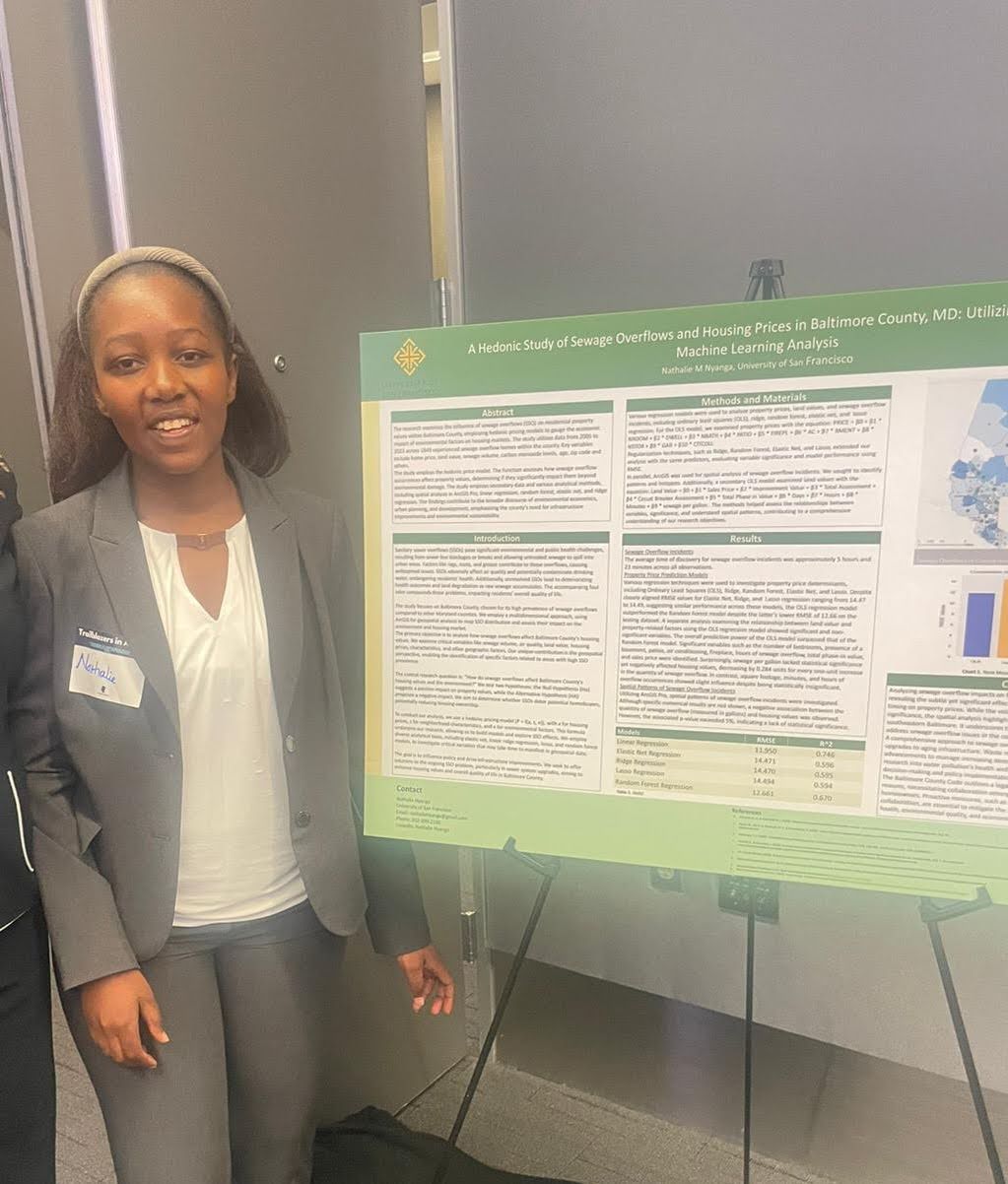
Flushed Away: Economic Consequences of Sewage Overflows
A study analyzing how sewage overflow events affect California housing markets, using spatial
econometrics and machine learning. Results highlight how environmental shocks shape real estate
expectations and pricing.
Explore My Work in Geospatial Analysis
These projects include ArcGIS mapping, geospatial dashboards, and Google Earth Engine analysis.